

The Spy Academy Review: Create Spy Puzzle Books for KDP, Etsy & TPT
If you publish low-content books, printable activity packs, or classroom worksheets, you already know how crowded the usual puzzle markets have become. Word searches, crosswords, sudoku books, dot-to-dots, and generic activity pages are everywhere. The Spy Academy enters the market with a different angle: spy, mystery, detective, cipher, and code-breaking activities that feel more like missions than ordinary worksheets.
The big promise behind The Spy Academy is simple but powerful. Instead of helping you create the same puzzle formats everyone else is uploading, it gives you access to an underserved activity book category built around mystery, investigation, secret messages, and puzzle-solving adventure. For KDP publishers, Etsy sellers, TPT creators, parents, teachers, and printable sellers, that is a compelling opportunity.
In this The Spy Academy review, we will look at what the software includes, how it works, who it is best for, what makes it different from typical activity book tools, and whether it is worth grabbing while founder pricing is available. If you want to build a more distinctive catalog instead of fighting in saturated puzzle niches, this review will help you decide whether The Spy Academy belongs in your publishing workflow.
What Is The Spy Academy?
The Spy Academy is a dedicated spy and mystery activity book creation platform powered by Activity Book Generator. It is designed to help users create print-ready puzzle books, worksheets, activity packs, and story-driven spy missions for platforms such as Amazon KDP, Etsy, Teachers Pay Teachers, Gumroad, local print shops, classrooms, and more.
Unlike a generic puzzle generator that simply lets you add spy-themed words to a familiar word search or crossword layout, The Spy Academy focuses on puzzle types that naturally belong inside the spy and mystery genre. That includes ciphers, code-breaking missions, secret messages, decoder activities, anagrams, and code word grids. These are the kinds of activities that make readers feel like they are solving an actual case rather than filling out another page of busywork.
The product also includes a commercial license, which means you can sell the PDFs and books you create. This matters because the software is clearly built with publishers and sellers in mind, not just hobby users. You can generate content, format it for your chosen marketplace, add your own cover and branding, and turn it into a product for sale.
Why the Spy and Mystery Angle Matters
The spy and mystery genre has a long history of capturing attention across age groups. Children love secret codes and hidden messages. Teens enjoy solving clues and uncovering plot twists. Adults are drawn to detective fiction, cozy mysteries, thrillers, escape-room-style challenges, and brain-training activities. That combination gives publishers a flexible content angle that can be adapted for many audiences.
The product information highlights the spy and mystery genre as a $22.5 billion opportunity that continues to grow. Whether you look at books, movies, streaming shows, games, or classroom activities, the culture around spies and mysteries is everywhere. From Sherlock Holmes and Agatha Christie to Enola Holmes, Spy Kids, Nancy Drew, The 39 Clues, City Spies, and modern cozy mystery trends, audiences already understand and enjoy this world.
That is important from a marketing standpoint. You are not trying to educate buyers about an obscure niche. You are giving them a product format that taps into a familiar emotional hook: the thrill of cracking the code, solving the mystery, and feeling smart. For a publisher, that is much stronger than competing with yet another generic word search book.
Key Features of The Spy Academy
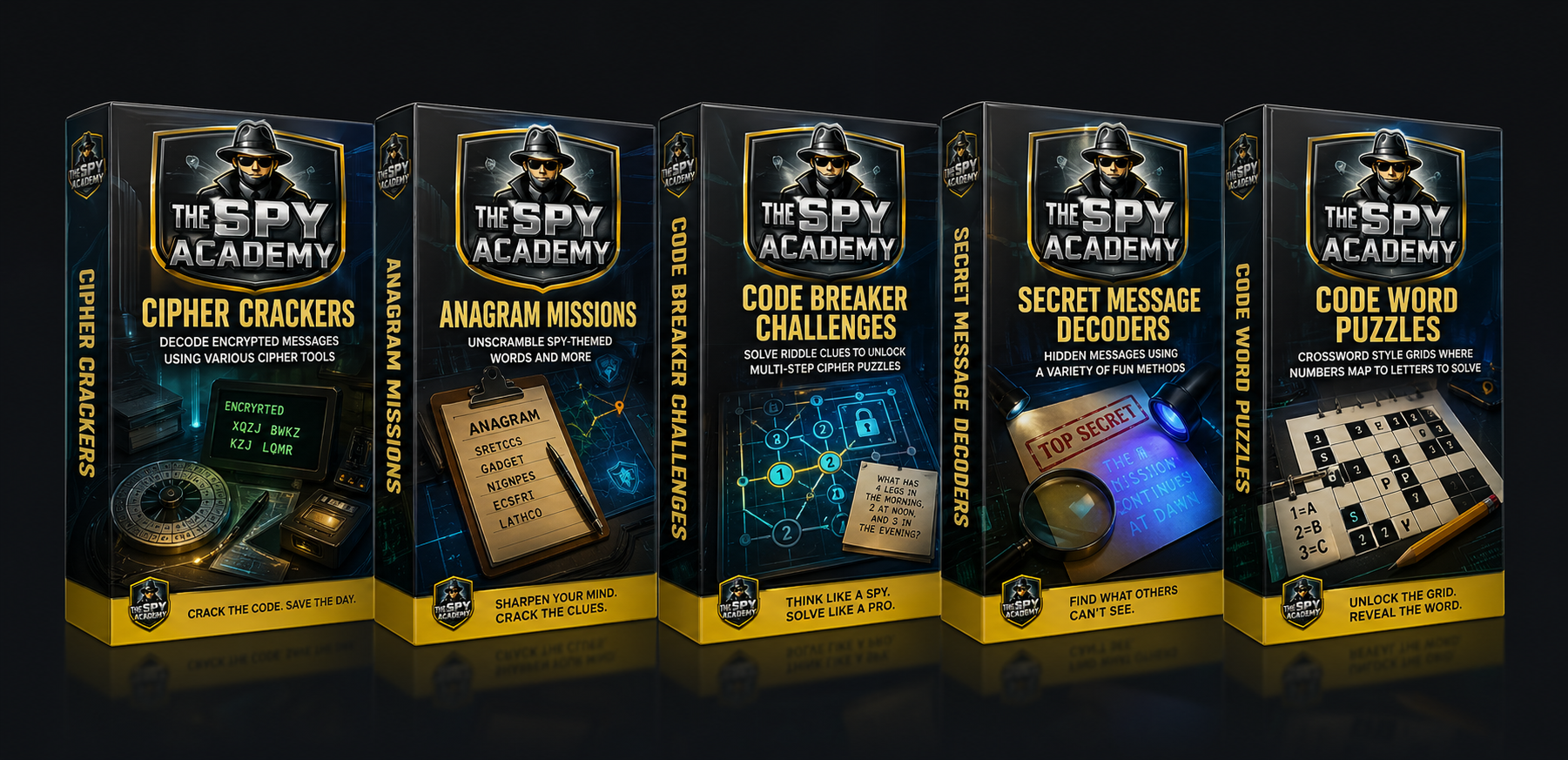
The Spy Academy includes five core puzzle generators plus an additional Spy Mission Books Builder. Each feature is designed to create a different type of spy-themed activity, giving you multiple product angles from a single tool.
1. Cipher Crackers
Cipher Crackers let you create encrypted spy messages that readers must decode. This is one of the strongest features because ciphers instantly create a sense of mission and secrecy. Instead of solving a plain puzzle, the reader is cracking an intercepted message.
- Includes multiple cipher methods such as Caesar Shift, Atbash Mirror, Number Code, Reverse Words, Substitution, Morse Code, Keyboard Code, Rail Fence, and Mirror Writing.
- Supports different difficulty levels from beginner-style recruit puzzles to more challenging field agent activities.
- Useful for children’s puzzle books, teen challenges, adult brain games, classroom activities, and themed printable packs.
- Can generate many variations, helping you create series-style products instead of one-off books.
2. Anagram Missions
Anagram Missions take the familiar word-unscrambling format and wrap it in a spy mission theme. This makes the puzzle more engaging while still keeping it accessible for younger readers or casual puzzle fans.
- Creates spy-themed word unscrambles with mission-style framing.
- Works well for fast printable packs, kids’ activity pages, classroom warmups, and travel activities.
- Easy for buyers to understand because the underlying puzzle type is familiar.
- More marketable than a plain anagram sheet because the spy theme adds story value.
3. Code Breaker Challenges
Code Breaker Challenges are multi-step puzzle activities where readers solve riddle clues and then use those answers to unlock cipher-based challenges. This is where The Spy Academy starts to feel less like a worksheet generator and more like an interactive mission builder.
- Includes several challenge types for variety.
- Encourages critical thinking, problem-solving, and sequencing.
- Strong fit for older children, teens, homeschool activities, classroom use, and advanced activity books.
- Helps create higher perceived value because readers must work through a mission rather than solve a single isolated puzzle.
4. Secret Message Decoders
Secret Message Decoders are designed around the excitement of revealing hidden messages. This feature is especially appealing for kids because hidden messages feel magical, playful, and rewarding. It also works well for teachers who want educational activities that do not feel like standard schoolwork.
- Includes five decoder methods for uncovering secret messages.
- Ideal for mystery-themed activity packs, party games, classroom exercises, and family activities.
- Can be used for standalone books or combined with other puzzle types.
- Useful for screen-free entertainment at home, on road trips, or in restaurants.
5. Code Word Puzzles
Code Word Puzzles use crossword-style grids where numbers map to letters. This gives readers the satisfaction of unlocking a full word grid while still staying within the code-breaking theme. It is a good bridge between traditional puzzle book buyers and the spy genre.
- Includes multiple grid sizes and starter-level options.
- Suitable for different ages and skill levels.
- Great for adult puzzle books, teen challenges, and mixed-age activity collections.
- Can be paired with ciphers and decoder pages to create more complete books.
6. Spy Mission Books Builder
The bonus-style feature that makes The Spy Academy even more interesting is the Spy Mission Books Builder. This AI-powered tool generates complete spy mission storybooks where narrative scenes, characters, objectives, plot twists, ciphers, code-breaking activities, and secret missions are woven together into a ready-to-publish PDF.
This is a major value add because story-driven activity books often have higher perceived value than simple puzzle collections. A child is not just solving random pages; they are moving through an adventure. For publishers, that opens up possibilities for series, themed missions, holiday spy adventures, classroom mystery units, and age-banded storybooks.
Publishing Options and Customization
The Spy Academy is built for people who actually publish, which means formatting options matter. The platform supports 16 page sizes, including common KDP trims, Etsy printable sizes, TPT worksheets, letter size, and A4. That flexibility lets you create products for different marketplaces without rebuilding everything manually.
You can also choose full-color or black-and-white output. Full color may work well for premium digital products, printable bundles, or visual activity books. Black and white is practical for KDP interiors, classroom printing, and low-cost home printing. The ability to choose per project gives you more control over production costs and buyer experience.
Answer keys are generated automatically, which is a major time saver. You can include them after each activity or at the end of the book, depending on the product you are creating. Font size options also make the content more accessible, with small, medium, large, and extra-large settings available for different reader groups.
How The Spy Academy Works
The workflow is intentionally simple. First, you choose the generator you want to use, such as Cipher Crackers, Anagram Missions, Code Breaker Challenges, Secret Message Decoders, or Code Word Puzzles. Then you choose the audience and difficulty level so the content matches your target buyer.
Next, you customize the layout. You can select the page size, font size, color style, and answer key settings. Once the settings are ready, you generate and download a print-ready PDF. From there, you can add a cover, bundle it with other files, upload it to a marketplace, or use it in your own classroom or local business.
This simplicity is a big part of the appeal. You do not need to understand Morse code, build cipher algorithms, design worksheets in Canva from scratch, or manually format answer keys. The software handles the puzzle logic and layout, while you focus on product strategy, branding, listing optimization, and publishing.
Benefits and Use Cases
The biggest benefit of The Spy Academy is differentiation. Most publishers are still creating the same puzzle book formats with minor theme changes. A spy cipher activity book immediately feels different because the puzzle itself matches the theme. That gives you a stronger hook for titles, covers, descriptions, and ads.
- KDP publishers: Build spy puzzle books, code-breaking series, mystery activity books, and AI-powered spy mission storybooks for different age groups.
- Etsy sellers: Create printable spy packs, rainy day activity bundles, birthday party mystery games, travel activity PDFs, and homeschool-friendly downloads.
- TPT creators: Offer classroom missions that teach problem-solving, pattern recognition, vocabulary, logic, and critical thinking.
- Parents and educators: Generate screen-free activities for road trips, weekends, rainy afternoons, summer learning, or family puzzle nights.
- Event planners and local businesses: Create custom mystery packs for camps, libraries, bookstores, after-school programs, and team-building activities.
Another important benefit is catalog expansion. Once you understand the workflow, you can create multiple products from one idea. For example, a beginner Caesar Shift book can lead to a Morse Code edition, a mixed cipher challenge book, a secret decoder workbook, and an ultimate spy mission collection. That kind of repeatable publishing system is valuable for anyone trying to build long-term assets.
Watch The Spy Academy Demo Video
Before looking at the pros and cons, watch the demo below to see how The Spy Academy presents the product and its spy puzzle creation workflow.
Pros and Cons of The Spy Academy
Pros
- Targets a highly engaging spy and mystery angle instead of saturated generic puzzle formats.
- Includes five dedicated puzzle generators plus an AI-powered spy mission storybook builder.
- Supports KDP, Etsy, TPT, Gumroad, local printing, and classroom use.
- Includes commercial rights, allowing you to sell the products you create.
- Offers multiple page sizes, font sizes, color options, and answer key controls.
- No monthly fees during the launch offer; it is positioned as a one-time payment.
- Strong potential for series-based publishing and repeatable product creation.
- Useful for multiple audiences, including kids, teens, adults, parents, teachers, and puzzle fans.
Cons
- You still need to do marketplace research, create good covers, write strong listings, and promote your products.
- Results depend on your niche selection, product quality, pricing, and publishing consistency.
- The spy and mystery angle is powerful, but it may not fit every seller’s existing brand.
- Because this is a launch offer, pricing and bonuses may change after the promotion ends.
- Beginners may still need to learn KDP, Etsy, or TPT marketplace basics to maximize the opportunity.
The Spy Academy vs Alternatives
The main alternative to The Spy Academy is not another identical spy puzzle generator, because this kind of dedicated tool is uncommon. The real alternatives are generic puzzle generators, Canva templates, AI writing tools, manual worksheet creation, or broader publishing tools. Those options can work, but they often require more time, more design effort, and more manual puzzle logic.
If your main interest is creating children’s books with AI-generated story content, you may also want to compare it with DreamForge AI, which focuses more on storybook creation for Amazon KDP. The difference is that The Spy Academy is purpose-built around spy missions, puzzle mechanics, ciphers, and activity content, while DreamForge AI is more relevant for general children’s storybook publishing.
For sellers who need help creating articles, reviews, or SEO content around their publishing products, ContentRyte may be a useful complementary tool. It is not a direct replacement for The Spy Academy, but it can help with content marketing if you plan to build a blog or niche site around printables, puzzle books, or educational resources.
If you are exploring broader AI product creation, AppsBuiltWithAI is another related review worth reading. However, for the specific goal of generating commercial spy and mystery activity books, The Spy Academy is more focused and easier to connect directly to KDP, Etsy, and TPT publishing workflows.
Real User Scenarios and Examples
Imagine a KDP publisher who has already released several word search books but is struggling to stand out. With The Spy Academy, that publisher could create a five-book series for ages 9 to 12. Volume one might focus on beginner Caesar Shift puzzles. Volume two could introduce Morse Code. Volume three could combine secret decoders. Volume four might use Code Breaker Challenges. Volume five could become an Ultimate Spy Challenge with mixed puzzle types and a stronger mission theme.
An Etsy seller could use the tool to create a printable spy activity pack in under an hour. They might choose three cipher types, set the difficulty for ages 6 to 10, use black-and-white letter size pages, include answer keys, download the PDF, create a simple cover image in Canva, and list the bundle as a rainy day spy mission pack or road trip activity kit.
A TPT creator could build a classroom mission workbook for fourth and fifth grade students. The product could include 15 Code Breaker Challenge pages, answer keys, and teacher instructions. The listing could position the activity as a fun way to practice logic, reading comprehension, problem-solving, and critical thinking without making students feel like they are doing another standard worksheet.
A parent or homeschool educator could create custom screen-free activities for a summer vacation. Instead of handing a child a tablet during every car ride, they could print a spy mission pack with secret messages, decoders, and anagrams. Because the activities feel like missions, children are more likely to stay engaged than they would with generic workbook pages.
A local library, camp, or bookstore could use The Spy Academy to create an event-based mystery challenge. The organizer could print mission pages, hide clues around the venue, and give children or families a complete spy experience. With commercial rights, this kind of product can also support workshops, paid events, or themed activity kits.
Bonuses Included During Launch
The launch offer includes several bonuses that make the package more practical for new users. The Field Report and Monetization Playbook is especially useful because many publishers struggle with niche research and product positioning. Having sub-niche ideas, demographics, pricing benchmarks, and monetization strategies can reduce the blank-page problem.
The quick-start video training is designed to help users move from purchase to first published product faster. That matters because tools are only valuable when they get used. The printable activity pack with commercial rights gives you a ready-made asset to study or potentially list. The Spy and Mystery Prompt Vault adds 150 organized story prompts, which can help you create more varied products and avoid repeating the same themes.
Who Should Buy The Spy Academy?
The Spy Academy is a strong fit for KDP publishers who want a fresh activity book category, Etsy sellers who want differentiated printable bundles, and TPT creators who want engaging classroom resources. It is also useful for parents, homeschoolers, educators, local businesses, and anyone who wants to create mystery-themed activities without designing every puzzle manually.
It is probably not the right fit if you are unwilling to publish, test ideas, create covers, write listings, or market your products. The software can generate the activity content, but it cannot guarantee sales. Like every publishing tool, it works best when paired with research, positioning, consistent output, and smart marketplace execution.
Get The Spy Academy
Final Verdict: Is The Spy Academy Worth It?
The Spy Academy stands out because it solves a real problem for activity book publishers: sameness. Many sellers are working hard, but they are using tools that create products nearly identical to what everyone else is making. By focusing on spy, mystery, ciphers, decoders, and story-driven missions, The Spy Academy gives you a more distinctive angle and a stronger emotional hook.
The software is especially attractive because it combines creativity with commercial practicality. You get print-ready PDFs, multiple page sizes, answer keys, difficulty controls, full-color or black-and-white output, unlimited PDF generation for the included activities, and commercial rights. That makes it useful not only for one book, but for building a catalog across different ages, puzzle types, and platforms.
Of course, no tool replaces smart publishing strategy. You still need to research your audience, create appealing covers, write optimized product descriptions, price competitively, and test your offers. But if you are tired of making the same books as everyone else, The Spy Academy gives you a fresh lane with real product differentiation.
At the current founder pricing, The Spy Academy is easy to recommend for KDP publishers, Etsy sellers, TPT creators, and educators who want to move into a more exciting activity book niche. If you want to create screen-free spy puzzle books, secret decoder packs, classroom missions, or full spy storybooks with commercial rights, this is the kind of tool that can help you move from idea to finished product much faster.
The smartest move is to get in while the category is still relatively open, build your first few products, and see which angles your audience responds to best. Spy and mystery content has lasting appeal because people love the feeling of solving something. The Spy Academy gives you a practical way to package that feeling into products you can publish, sell, and scale.