

OneManArmy Review: Can One Dashboard Really Run an AI Army for Solo Operators?
Most AI tools create a new kind of workload: prompts to manage, tabs to switch between, API keys to configure, outputs to copy, and context to re-explain every time you start a new task. OneManArmy is built around a different promise: instead of giving you another chatbot, it gives you a hosted command dashboard where three specialized AI workers can operate side by side.
The core idea is simple but strategically important. Solo operators do not just need better AI answers; they need planning, execution, and memory working together. That is where OneManArmy positions itself: Paperclip acts as the planning layer, OpenClaw handles execution, and Hermes provides persistent business memory and intelligence.
This matters now because the AI market is moving from single-prompt productivity toward agentic workflows. In 2026, the advantage is not merely knowing how to use ChatGPT. The advantage is building repeatable systems where AI can plan campaigns, execute tasks, remember client preferences, and operate with human approval. OneManArmy is aimed directly at that shift.
If you are already paying for several AI subscriptions, experimenting with open-source agents, or considering an AI service business, it is worth taking a closer look at OneManArmy and its current launch offer. The real question is not whether it sounds impressive. The real question is whether the workflow makes practical business sense.
Quick Verdict: Is OneManArmy Worth It?
OneManArmy is best for solo founders, freelancers, creators, small agencies, and local business consultants who want a hosted AI agent stack without dealing with Docker, servers, API keys, or fragmented monthly tools. Its strongest value is not one individual bot. The value is having planning, execution, memory, messenger access, and a growing AI agent library inside one operating dashboard.
| Best for | Solo operators, AI service providers, agencies, creators, affiliate marketers, local business consultants |
| Not ideal for | Users expecting fully autonomous revenue with no strategy, oversight, or client acquisition |
| Pricing positioning | Launch pricing, one-time payment positioning, 14-day money-back guarantee according to the vendor |
| Ease of use | Beginner-friendly compared with self-hosted AI agent stacks |
| Overall recommendation | Strong fit if you want to productize AI workflows or reduce operational drag across content, outreach, research, and client work |
What Is OneManArmy?
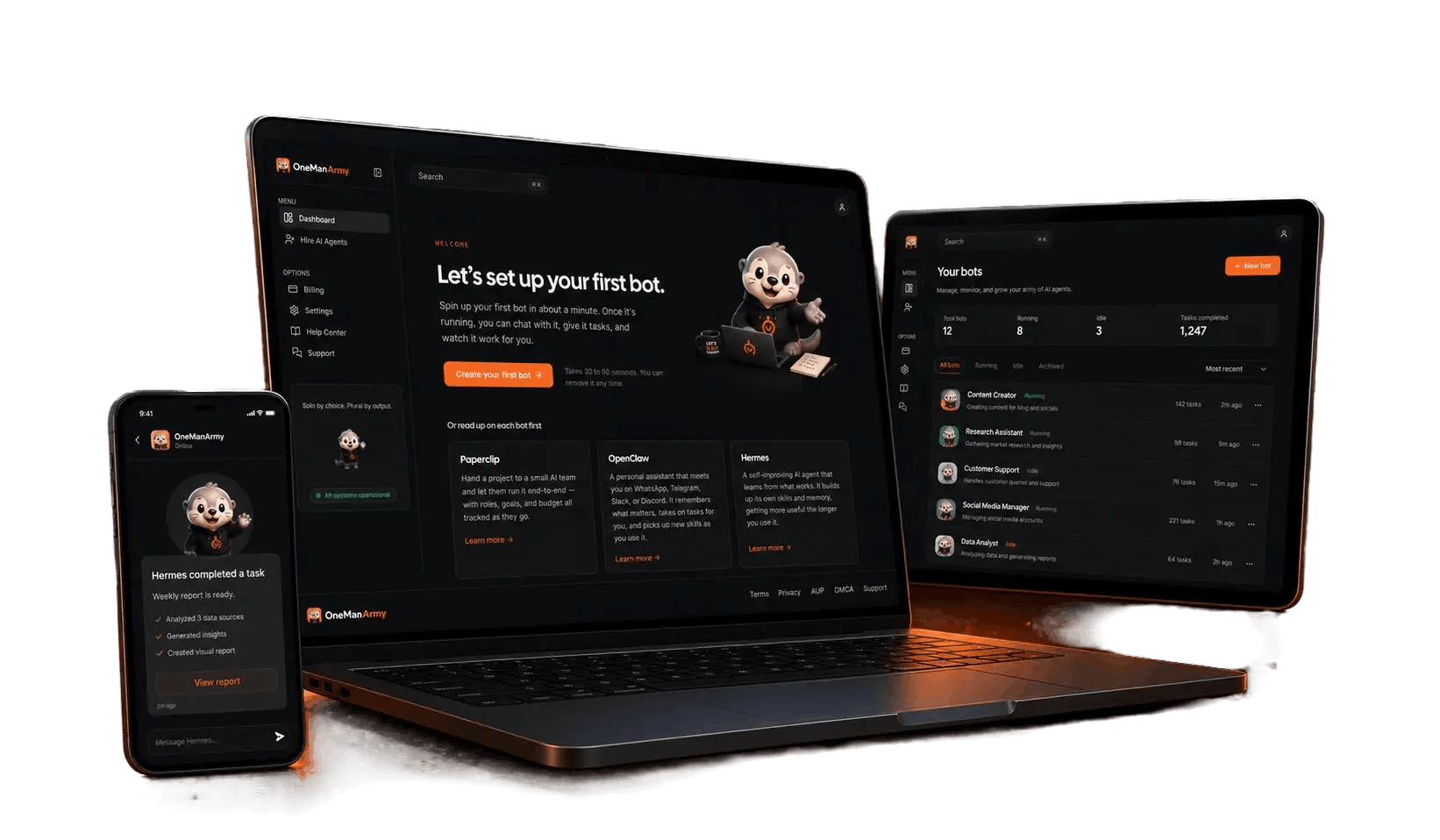
OneManArmy is a hosted AI command dashboard designed to let one person deploy and manage three AI bots from a single interface. Instead of asking you to self-install open-source projects or manually connect multiple tools, it packages the stack into a browser-based dashboard with guided deployment.
The platform centers on three distinct roles. Paperclip is the AI Commander, designed to break goals into roles and manage a project-style workflow. OpenClaw is the AI Field Operator, built for skills, actions, and execution. Hermes is the AI Intelligence Specialist, focused on business memory, self-learning workflows, and consistent context across clients or campaigns.
The practical value proposition is clear: OneManArmy tries to remove the technical friction that stops non-engineers from using advanced AI agents. No terminal. No Docker setup. No server configuration. No API key hunting at the beginning. For many users, that hosted layer is the actual product.
Key Features and Why They Matter
1. The Command Dashboard
The dashboard is the control center for deploying, monitoring, pausing, resuming, and restarting bots. This is important because AI agents are only useful when you can see what they are doing and control their state. A scattered stack of tools can quickly become harder to manage than the work itself.
For agencies managing multiple clients, visibility matters. If a content task, outreach sequence, or research workflow fails silently, you lose trust with the client. OneManArmy’s dashboard-style approach gives operators a clearer way to manage AI activity without constantly jumping between platforms.
2. Paperclip as the Planning Layer
Paperclip is positioned as the AI CEO or Commander. In practical workflows, this matters because many AI failures begin with poor task decomposition. A vague goal such as “grow this local dentist’s online presence” needs to be broken into roles: local SEO, review response, email follow-up, content, and reporting.
Paperclip’s request-to-hire model is useful because it keeps the human operator in control. Instead of blindly running tasks, it proposes roles and waits for approval. This is especially valuable for beginners who want structure and for agencies that need quality control before AI-generated work touches a client account.
3. OpenClaw as the Execution Layer
OpenClaw is the doer. It is designed for running skills, chaining workflows, executing web tasks, managing files, and operating from web, Telegram, or Discord. This becomes valuable when you want AI to move beyond advice into operational work.
The biggest business impact is speed. A freelancer can use OpenClaw-style workflows to research leads, draft outreach, prepare content, and assemble client assets faster than doing everything manually. The key is still human review, but the blank-page and repetitive-task burden is reduced.
4. Hermes as the Memory Layer
Hermes is the most strategically interesting part of the stack because memory is where many AI workflows break. Without persistent business memory, every new task starts from zero. You re-explain your offer, brand voice, audience, past campaigns, client preferences, and quality standards.
Hermes is designed to remember your business across clients and campaigns. This is particularly useful for agencies, content teams, consultants, and creators who need consistency. The more often you work with the same client or brand, the more valuable memory becomes.
5. AI Agent Library With One-Click Hire
OneManArmy includes a growing library of pre-built AI roles, including content writers, SEO specialists, sales leads, customer support leads, local SEO specialists, review response managers, proposal writers, newsletter editors, outreach specialists, and social platform specialists.
The hidden strength here is productization. Instead of starting every workflow from a blank prompt, you can package services around repeatable roles. A local business consultant could offer review responses, Google Business Profile optimization, and weekly social posts. A creator could deploy content repurposing, newsletter editing, and short-form scriptwriting.
6. Messenger Integrations
Telegram, Slack, and Discord integration matters because real operators do not live inside one dashboard all day. Approval pings, status updates, and quick instructions from a phone can make the difference between a workflow that gets used and a workflow that gets abandoned.
This is particularly useful for creators, agency owners, and consultants who work between calls, client meetings, or travel. If you can approve a task from Slack or send a follow-up instruction from Telegram, the AI system becomes part of your day instead of another platform you forget to open.
7. Hosted Setup and Complimentary API Access
One of the most overlooked weaknesses of many AI agent tools is setup friction. The vendor correctly identifies the problem: many people can read about powerful open-source bots, but they cannot reliably run them. Docker errors, VPS setup, API funding, provider limits, and broken updates can kill momentum before a single useful task is completed.
OneManArmy’s hosted setup and complimentary API access are conversion-critical features because they address the main adoption blocker. The ROI is not just in the bots. The ROI is in avoiding the weekend lost to infrastructure work.
If that setup friction is what has stopped you from experimenting with agents, review the OneManArmy access details here before comparing it with self-hosting options.
Real Use Cases for OneManArmy
For Marketers
Marketers can use OneManArmy to plan campaigns, generate content briefs, research audiences, draft cold emails, create social posts, and maintain campaign memory. Paperclip can structure the campaign, OpenClaw can execute research and drafting tasks, and Hermes can preserve positioning, tone, and previous performance notes.
For Creators
Creators can use the system to repurpose one idea into newsletters, X posts, LinkedIn posts, video scripts, and community updates. This is especially relevant in the creator economy, where output consistency often matters more than one perfect piece of content.
For Freelancers
Freelancers can use OneManArmy as an operations assistant. Proposal writing, client onboarding, research, drafts, follow-ups, and delivery documents can all be systemized. The productivity gain comes from reducing admin work and increasing deliverable volume without immediately hiring subcontractors.
For Agencies
For agencies managing multiple clients, OneManArmy is most useful as a repeatable delivery layer. Use Hermes to preserve client voice, Paperclip to structure projects, and OpenClaw to run execution workflows. This can reduce the constant context-switching that burns agency owners out.
For Ecommerce Businesses
Ecommerce operators can use the AI agent library for product descriptions, email campaigns, customer feedback analysis, returns insight, social content, and promotional planning. The best use case is not replacing your ecommerce platform; it is speeding up the marketing and customer insight work around it.
For Local Businesses
Local businesses can use OneManArmy through an operator or consultant for review responses, Google Business Profile support, local SEO content, appointment flow copy, and social media. This creates a practical service opportunity for freelancers who want recurring retainers.
For Automation Workflows
OneManArmy fits well into automation workflows where AI prepares, reviews, drafts, or routes work before a human approves final output. It can complement tools like Zapier, Make, Slack, Discord, Telegram, CRMs, and content management systems. If you are comparing broader autonomous agent tools, you may also find this related review useful: Agentix Agents review.
Benefits Analysis: What Actually Changes in Your Business?
The main benefit of OneManArmy is operational leverage. Instead of manually moving from planning to research to writing to execution to follow-up, you can assign roles and create a more structured workflow. The platform does not remove your responsibility as the operator, but it can reduce the amount of repetitive labor required to move projects forward.
Another benefit is faster service packaging. A freelancer can turn the AI agent library into sellable offers: cold email setup, local SEO support, social media management, newsletter production, product description writing, or review response management. These are services businesses already understand and already pay for.
The productivity impact is strongest when you have repeatable work. If every project is completely custom, you will still need substantial human input. But if you repeatedly create briefs, posts, emails, reports, proposals, client updates, or campaign plans, OneManArmy can help turn those tasks into a structured operating system.
What Most Reviews Don’t Tell You About OneManArmy
The most important insight is that OneManArmy should not be evaluated like a normal chatbot. A chatbot helps you answer questions. OneManArmy is trying to become an execution environment for AI-assisted operations. That difference changes how you should judge it.
The hidden strength is workflow architecture. Combining a planner, doer, and memory layer makes more sense than relying on one general-purpose AI assistant. In real business work, planning without execution creates strategy documents nobody implements. Execution without memory creates generic output. Memory without task management creates notes without momentum.
The overlooked weakness is that orchestration still requires judgment. Someone must decide what matters, approve sensitive actions, review quality, and build the business model around the output. OneManArmy can give you a stronger bench, but it does not magically create positioning, offers, client trust, or distribution.
Another under-discussed point is client service potential. The vendor highlights that people charge to install or manage these bots. The bigger opportunity may be packaging ongoing AI operations for local businesses, agencies, coaches, and ecommerce brands that do not care what the bots are called. They care about answered reviews, posted content, researched leads, and booked appointments.
Who OneManArmy Is Best For
- Solo founders who need planning, execution, and memory without hiring a team.
- Freelancers who want to increase delivery capacity and package AI-powered services.
- Agencies managing content, outreach, local SEO, reporting, and client communication.
- Creators who need consistent content repurposing across platforms.
- Affiliate marketers building review content, email sequences, lead magnets, and social campaigns.
- Local business consultants selling review response, social posting, lead research, or AI setup services.
- Ecommerce operators needing product copy, email marketing, customer insight, and social content support.
Who Should Avoid OneManArmy
OneManArmy is not ideal for users who expect AI to run a business with no direction. If you do not have an offer, audience, niche, client base, or clear workflow, the platform will not invent a profitable business for you automatically.
It may also be a poor fit for enterprise teams with strict procurement, compliance, data residency, and custom infrastructure requirements. Those teams usually need detailed security reviews, admin controls, audit logs, and integrations beyond what launch-focused AI platforms typically offer.
Developers who enjoy self-hosting and want full infrastructure control may prefer installing and modifying open-source bots directly. OneManArmy is designed more for speed and convenience than for deep technical customization.
Honest Limitations
The biggest limitation is quality control. AI agents can draft, research, summarize, and execute, but their outputs still need review. This is especially true for outreach, legal-adjacent content, medical topics, financial claims, client communications, and anything published under your brand.
Another limitation is dependency on the hosted environment. Hosted convenience is a benefit, but it also means you rely on the platform’s uptime, updates, support, and infrastructure decisions. Serious users should understand export options, key ownership, data handling, and how long complimentary API access lasts for their chosen tier.
There is also a learning curve, even if no code is required. Beginners will need to learn how to brief agents, approve work, set boundaries, evaluate outputs, and design workflows. The included Operator’s Academy helps, but users should still expect an implementation period.
Finally, scalability depends on your use case. Running AI workflows for yourself is different from managing dozens of client accounts. Agencies should test naming conventions, memory separation, approval flows, and reporting processes before promising large-scale client delivery.
OneManArmy Compared With Alternatives
| Option | Best For | Main Difference |
|---|---|---|
| ChatGPT or Claude | General writing, brainstorming, analysis | Powerful but not a dedicated multi-agent operating dashboard |
| Self-hosted open-source agents | Developers and technical operators | More control, but more setup and maintenance burden |
| Single-bot hosted wrappers | Users who need one specific agent | Simpler, but lacks full planning-execution-memory stack |
| OneManArmy | Solo operators who want an AI operations bench | Combines Paperclip, OpenClaw, Hermes, agent library, hosting, and training |
Compared with a tool focused only on OpenClaw-style workflows, OneManArmy’s advantage is broader orchestration. If you specifically want to compare OpenClaw-based marketing automation, see this related analysis: OmniClaw AI review.
ROI and Business Impact
The ROI makes sense when OneManArmy saves either time, tool costs, or delivery labor. If it replaces several subscriptions, helps you avoid technical setup, or lets you fulfill paid services faster, the business case becomes easier to justify.
For example, one local business client paying a monthly retainer for review responses, social posts, or email support could cover the cost of many launch-priced AI tools. The more important question is whether you can sell and manage the service responsibly. AI gives leverage; it does not replace client acquisition.
Time savings can also be substantial for creators and agencies. Content repurposing, research, briefs, first drafts, client updates, and campaign outlines are repetitive tasks that consume hours every week. Even if OneManArmy only reduces 30% of that workload, the compounded effect across months can be meaningful.
For affiliate marketers, the monetization opportunity is building faster review workflows, comparison content, email campaigns, and traffic systems. If AI search visibility is part of your strategy, you may also want to study related workflows in this AI Visibility System review.
AI and Automation Compatibility
OneManArmy fits naturally into ChatGPT-style workflows because it can act as the operational layer after ideation. You might brainstorm an offer in ChatGPT, then use Paperclip to break it into roles, OpenClaw to execute tasks, and Hermes to remember the brand voice and campaign decisions.
For automation systems, OneManArmy is most useful as an AI worker layer rather than a replacement for every automation tool. Zapier, Make, CRMs, calendars, email platforms, and analytics tools still matter. OneManArmy can help generate, summarize, route, and prepare work that those systems then distribute or track.
For agencies, the ideal implementation is to create repeatable playbooks: client onboarding, brand voice capture, weekly content generation, review monitoring, reporting, and follow-up. For creators, the best workflow is turning one core idea into multiple assets while Hermes maintains consistent voice.
For lead generation systems, the most practical use cases are lead research, cold email drafting, LinkedIn message planning, CRM follow-up drafts, and campaign reporting. Sensitive outreach should still be reviewed by a human before sending, especially if deliverability and compliance matter.
OneManArmy Demo Video
Pros and Cons
Pros
- Combines planning, execution, and memory layers in one dashboard.
- Removes technical friction from running advanced AI bots.
- Hosted, browser-based, and designed for fast deployment.
- Useful agent library for monetizable services.
- Messenger integrations support mobile-first operations.
- Commercial license and training improve practical implementation.
- Strong fit for freelancers, agencies, creators, and local consultants.
Cons
- Still requires human strategy, review, and client management.
- Hosted dependency may not suit users who need full infrastructure control.
- Beginners must learn how to brief and manage AI agents effectively.
- Output quality will vary by task complexity and instruction quality.
- Not a substitute for a real offer, audience, or sales process.
Final Verdict: Should You Get OneManArmy?
OneManArmy is one of the more interesting AI business tools because it focuses on orchestration rather than another isolated prompt box. The combination of Paperclip, OpenClaw, Hermes, hosted deployment, messenger access, and a pre-built agent library gives solo operators a practical way to experiment with AI operations.
My recommendation is straightforward: consider OneManArmy if you already have work that can be systemized. Content production, outreach, local business services, ecommerce marketing, client onboarding, research, reporting, and social media are all strong fits. The platform becomes valuable when you use it to build repeatable workflows, not when you treat it as a magic button.
Skip it if you want a passive income machine with no oversight. Buy it if you want to become a better operator with an AI bench behind you. The difference matters.
If your goal is to save setup time, reduce subscription sprawl, and test a real AI operations stack, explore OneManArmy while launch pricing is available. Treat the first week as an implementation sprint: deploy one bot, choose one workflow, create one measurable outcome, and build from there.
FAQ
What is OneManArmy used for?
OneManArmy is used to run AI-assisted business workflows from one dashboard. Common uses include planning campaigns, executing research and content tasks, managing client memory, drafting outreach, creating social content, and packaging AI services for clients.
Is OneManArmy better than ChatGPT?
It depends on the job. ChatGPT is excellent for conversation, writing, brainstorming, and analysis. OneManArmy is better suited for users who want a structured AI operations dashboard with planning, execution, memory, agent roles, and messenger-based workflows.
Do I need technical skills to use OneManArmy?
No coding or server setup is required for the core hosted experience. That is one of the main reasons the product exists. However, you still need to learn how to give clear instructions, review outputs, and design useful workflows.
Can agencies use OneManArmy for clients?
Yes. Agencies can use OneManArmy to support content production, local SEO, review responses, outreach drafts, onboarding, reporting, and campaign planning. The commercial license positioning makes it especially relevant for client services, but agencies should still create quality control processes.
Can OneManArmy help me start an AI service business?
It can help with delivery, packaging, and operational leverage. Services such as cold email support, local SEO, review management, social media content, newsletters, and AI setup can be built around the platform. You will still need to sell, onboard clients, and manage expectations.
What is the biggest risk with OneManArmy?
The biggest risk is overestimating autonomy. AI agents can accelerate work, but they should not be left unsupervised for sensitive tasks. The best users will keep approval checkpoints, review outputs, and use the platform as leverage rather than replacement judgment.
Does OneManArmy include training?
According to the product details, OneManArmy includes access to the Operator’s Academy, a platform-specific training program covering first deployment, bot roles, brand voice, outreach campaigns, messenger setup, approval flows, and scaling from solo use to agency workflows.
Who gets the most value from OneManArmy?
The users who get the most value are those with repeatable workflows: agencies, freelancers, creators, local business consultants, affiliate marketers, and ecommerce operators. If you can turn tasks into repeatable playbooks, the AI army concept becomes much more useful.